Quick answer
- DeepSeek V4.1 Flash introduces an asymmetric Causal Encoder-Decoder Mixture-of-Experts (MoE) architecture with 552B total parameters, but activates only 8B parameters during input encoding and 16B during output generation.
- The model establishes a breakthrough in serving efficiency: its compressed KV cache requires just 1/4 the High Bandwidth Memory (HBM) and 1/8 the SSD storage of previous architectures, significantly reducing context-caching hosting costs.
- Unlike earlier text-only iterations, V4.1 Flash integrates native visual understanding directly into the base weights, eliminating separate vision-encoder latency for image inputs and UI debugging.
- Benchmark evaluations place V4.1 Flash ahead of the earlier V4-Pro across agentic coding, mathematical reasoning, and total inference throughput, prompting DeepSeek to route legacy V4-Pro endpoints to V4.1 Flash at discounted rates.
- API pricing maintains DeepSeek's low-cost posture with distinct peak and off-peak rate tiers, offering a 50% discount for scheduled background workloads.
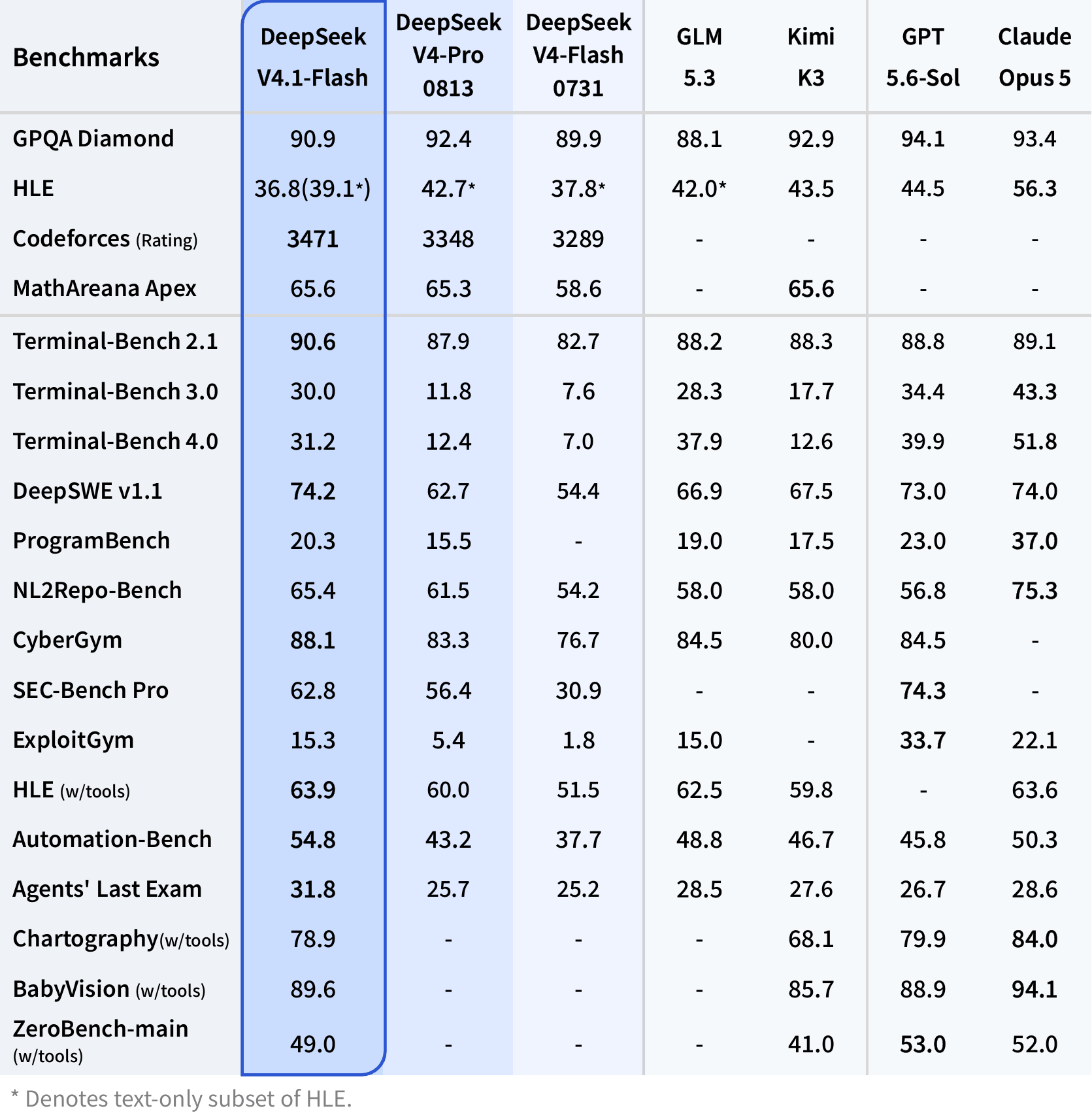 Image source: DeepSeek Official Announcement / DeepSeek AI
The foundation model landscape has seen rapid parameter inflation, but the practical barrier to deploying autonomous software agents is no longer model size—it is serving throughput and KV cache memory starvation. When hundreds of concurrent agents iterate over 100K+ token codebases, traditional dense and symmetric MoE models exhaust GPU VRAM rapidly.
With DeepSeek V4.1 Flash, DeepSeek has restructured the inference equation. By combining an asymmetric encoder-decoder routing mechanism with radical KV cache compression, V4.1 Flash delivers frontier-class reasoning speed at a fraction of standard infrastructure overhead.
Here is a technical analysis of the V4.1 Flash architecture, its memory scaling advantages, and its operational trade-offs.
Asymmetric MoE: 8B input and 16B output activation
Most conventional Mixture-of-Experts (MoE) models use symmetric feed-forward networks (FFNs), activating the same fixed number of experts for both prompt processing (prefill) and token generation (decode).
V4.1 Flash departs from this standard with an Asymmetric Causal Encoder-Decoder configuration:
- Total Parameter Footprint: 552 billion parameters across the entire expert pool.
- Input Prefill Stage (8B Active Parameters): Ingesting large context windows (such as codebases, documentation, or image tokens) engages only 8B active parameters. This keeps the prefill phase exceptionally fast and computationally light, drastically reducing time-to-first-token (TTFT).
- Output Decode Stage (16B Active Parameters): When synthesizing code, reasoning traces, or multi-step action plans, the routing layer expands to 16B active parameters. This provides the higher parametric capacity needed for precise syntax generation and logical deduction.
This asymmetric ratio addresses the fundamental asymmetry of real-world developer workloads: prompt inputs are typically massive (50K to 500K tokens), while generated responses are comparatively compact (1K to 8K tokens).
The KV cache breakthrough: 1/4 HBM and 1/8 SSD storage
The primary bottleneck in long-context inference is the Key-Value (KV) cache. For every token in an active conversation, attention keys and values must reside in ultra-fast High Bandwidth Memory (HBM) on the GPU or fast NVMe swap storage.
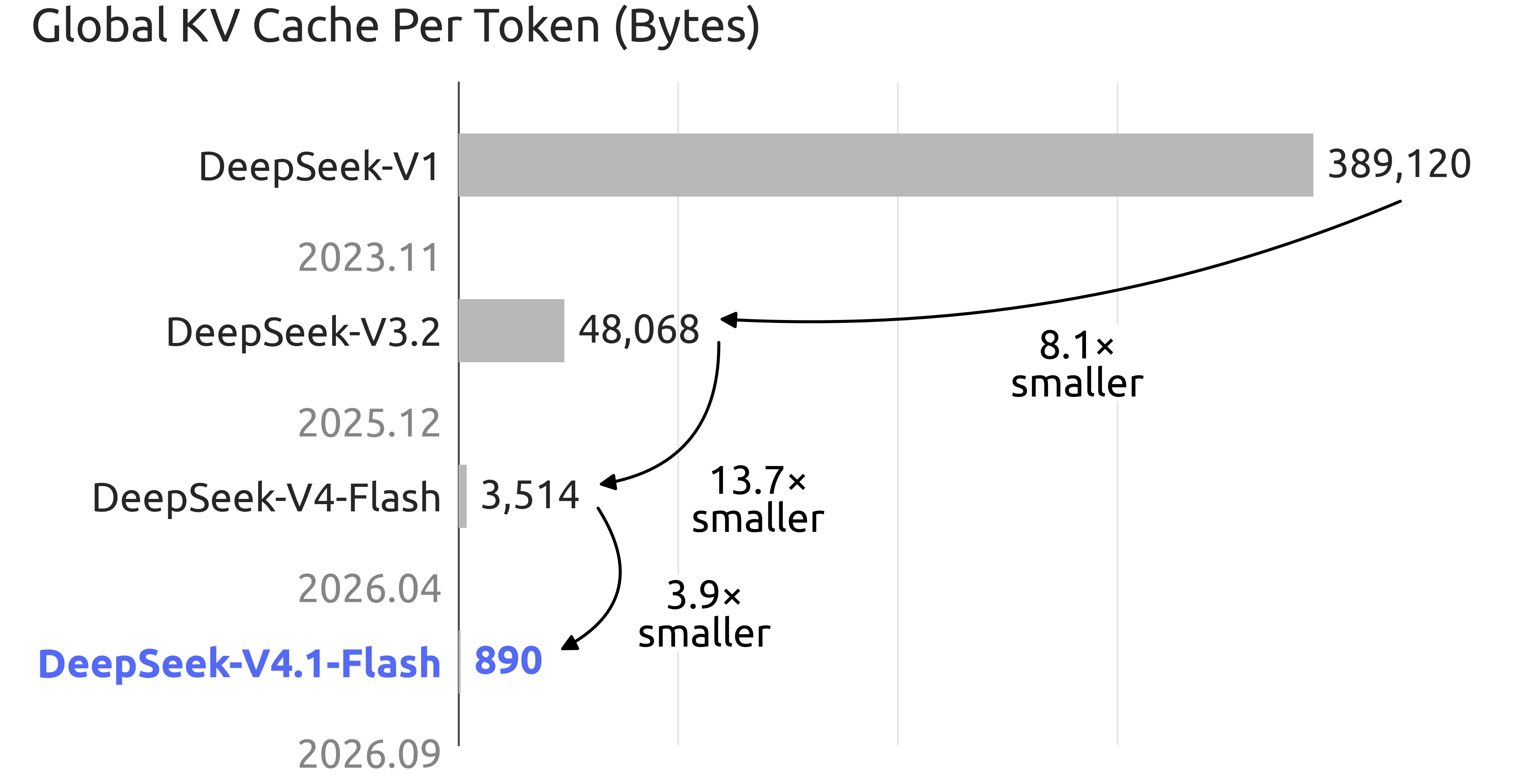 Image source: DeepSeek Technical Blog / DeepSeek AI
DeepSeek V4.1 Flash integrates multi-head latent attention (MLA) with advanced rotary positional compression, slashing KV cache requirements:
- 75% Less GPU Memory (1/4 HBM): In production clusters, serving a 1-million-token context requires only one-fourth of the VRAM needed by typical models. This allows hosting providers to pack four times as many concurrent agent sessions onto a single 8x H100/H800 node.
- 87.5% Less Disk Footprint (1/8 SSD): For persistent context caching—where static repositories or developer documentation remain pre-cached on server storage—disk write throughput and storage demands drop by 8x.
- Cache-Hit Economy: Because KV cache storage represents a dominant portion of long-context token billing, this physical reduction directly underpins DeepSeek's discounted cache-hit pricing.
Native multimodal vision and agentic performance
Previous iterations required specialized sub-models (such as deepseek-v4-flash-vision-exp) to process screenshots and diagrams. V4.1 Flash unifies multimodal vision natively into the primary model weights.
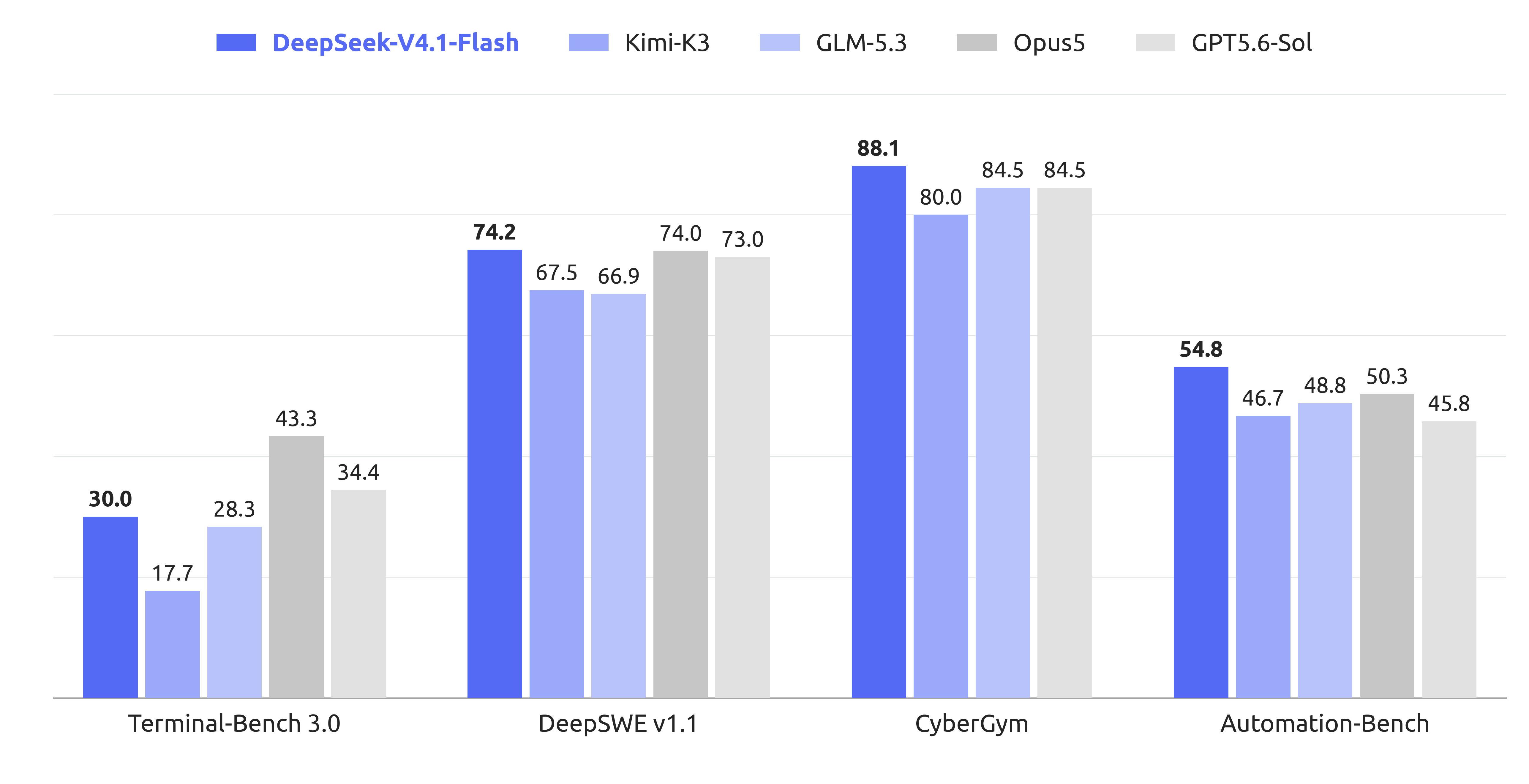 Image source: DeepSeek Official Architecture Data / DeepSeek AI
In agentic coding workflows—such as analyzing UI layout regressions in mobile apps, inspecting architecture diagrams, or diagnosing web rendering bugs—native vision allows the model to correlate visual coordinate data directly with underlying code files without serialization overhead.
On standard multi-step coding and agentic benchmarks, V4.1 Flash consistently surpasses the earlier V4-Pro flagship model across execution speed, pass-at-1 rates, and total wall-clock runtime. This performance parity led DeepSeek to announce the complete deprecation of V4-Pro, routing all legacy endpoints to V4.1 Flash.
The table below contrasts V4.1 Flash against recent MoE architectural generations.
| Architectural Feature | DeepSeek V3 / V4 Early | DeepSeek V4.1 Flash | Practical Developer Implication |
|---|---|---|---|
| Total Architecture | Symmetric MoE | Asymmetric Causal MoE | Lower prefill latency on large prompts |
| Active Parameters (Input) | ~21B – 37B Active | 8B Active | Dramatically faster time-to-first-token |
| Active Parameters (Output) | ~21B – 37B Active | 16B Active | High-precision code generation |
| KV Cache HBM Usage | Baseline (1.0x) | 0.25x (75% Reduction) | Higher concurrency per server cluster |
| Multimodal Support | Separate Vision Experimental | Native in Base Model | Unified text and image tool calling |
| Context Window | 128K – 1M Tokens | 1M Tokens | Full repository and log ingestion |
API economics: Peak versus off-peak scheduling
DeepSeek continues its practice of passing infrastructure efficiencies directly into developer pricing, incorporating time-of-day dynamic load balancing:
- Standard Peak Pricing: Extremely competitive base rates that maintain DeepSeek's position as one of the lowest-cost token providers globally.
- Off-Peak Window (50% Discount): Workloads scheduled during global low-demand hours receive an automatic 50% discount on both input and output tokens. This makes V4.1 Flash ideal for overnight batch code refactoring, automated documentation generation, and unit-test synthesis.
- Ecosystem Integration: Toolchains including OpenCode and WorkBuddy/CodeBuddy have integrated V4.1 Flash natively, supporting both standard completions and reasoning chain-of-thought tracking.
Summary verdict
DeepSeek V4.1 Flash demonstrates that the race for practical AI capability is shifting from brute-force scale to architectural elegance. By pairing an asymmetric 8B/16B activation model with a radical 75% reduction in KV cache memory consumption, DeepSeek has produced a fast, natively multimodal foundation model that makes high-volume agentic coding economically viable.
For developers and engineering teams running multi-turn coding assistants, V4.1 Flash delivers the responsiveness of an 8B model with the reasoning depth of a massive MoE.
Sources and further reading
- DeepSeek AI, "Introducing DeepSeek-V4.1-Flash: Smarter, Faster, More Efficient", Official News Release (September 2026).
- DeepSeek AI Technical Team, "DeepSeek-V4.1-Flash Model Architecture, MLA Enhancements, and KV Cache Optimization Whitepaper".
- BenchLM, "DeepSeek Models Compared: V4.1 Flash vs V4 Pro Benchmarks and Throughput Analysis" (October 2026).