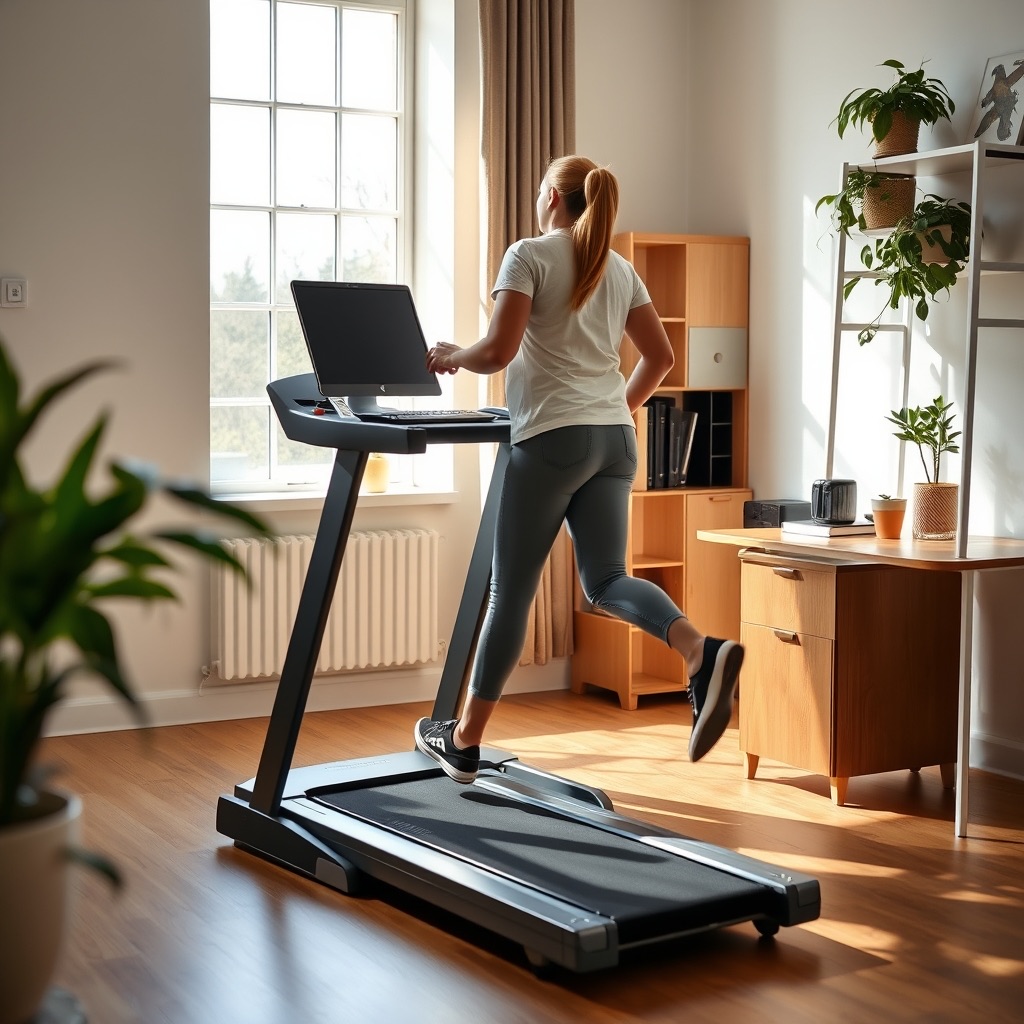
Start with the desk, not the walking pad
Walking pads — the flat, low-speed treadmills sold for under-desk use — fail in home offices for a mundane reason: the desk cannot go high enough, or the deck leaves no room for a natural stride. Everything else on a spec sheet is negotiable. This constraint is not, and you can check it before spending anything.
A walking pad raises your feet above the floor by the height of its deck and belt, and that height adds to your normal standing desk height. If you type comfortably with the desk at 105 cm and a candidate pad sits 10 cm off the floor, the desk needs to reach roughly 115 cm. A desk that tops out at 110 cm makes the pad the wrong purchase no matter how good its motor is. ISO 9241, the ergonomics-of-human-system-interaction standard, addresses workstation layout and posture — in effect, where the work surface sits relative to the user — and a fixed-height desk under a raised deck breaks that relationship.
Stride room is the second measurement. Tape the pad's footprint on the floor and stand on it at your meeting pace. Your feet travel forward and back even at slow speeds, so leave space in front of and behind the desk, not just underneath it. Folded height matters if the pad will live under the desk, since a folded unit can block chair casters, a footrest, or a drawer pedestal.
One knock-on purchase is often worth making. Moving between sitting and walking changes your eye height by roughly the deck height, which can be more than the adjustment range built into a monitor stand. A height-adjustable arm solves that without new furniture; View product details for one dual-monitor option.
The number that matters is the slowest speed
Manufacturers advertise top speed because it is the bigger number. For walking meetings, the minimum speed decides whether the pad is usable. If the slowest setting is faster than your natural typing pace, you spend the call braking instead of reading. Get the minimum speed as a documented figure, not a listing bullet.
Check the unit as well. A pad listed at "3.0" is either 3 mph (about 4.8 km/h) or 3 km/h, and the difference determines whether you can talk and type at the same time.
Deck dimensions should be measured against your stride rather than your height alone. Mark a relaxed step on the floor from back heel to front heel at the pace you would actually walk on a call, then compare that to the usable deck length with some margin at each end. Narrow belts demand precise foot placement, which becomes irritating twenty minutes into a call. Wider decks take more floor space and usually weigh more.
If incline is listed, establish whether it is manual or motorized and how much it adds to deck height. That figure feeds back into your desk clearance calculation.
Motor, belt, and frame: what to verify in writing
Peak horsepower is marketing. Ask for the continuous duty rating, given in watts or continuous horsepower, from the specification sheet or manual. A pad rated only in peak horsepower tells you little about holding a steady pace for forty minutes.
Manufacturers generally state that brushless motors are quieter and longer lasting than brushed motors, so confirm the motor type in the documentation rather than a retailer bullet point. Belt construction matters for the same reason: multi-layer belts with an anti-slip surface are described as more durable than single-layer belts, and the belt is the part you replace first. Frames are commonly steel, sometimes with a stated gauge or thickness, while aluminium saves weight at the cost of rigidity. "Commercial grade" has no agreed definition, so treat it as an adjective until a certification or duty rating backs it up.
Weight capacity deserves a careful read. The user manual may separate static and dynamic capacity, and a retail listing may quote only the larger number. Dynamic capacity is the one that applies while the belt is moving.
Noise claims need a number attached
"Quiet" without a decibel figure is not a specification. A usable claim names the sound level at a stated speed and a stated distance from the machine. Without both, the figure cannot be checked.
Your floor is half the equation. Belt hum travels through the air, footfalls travel through the structure, and the same pad behaves differently on a concrete slab with carpet than on a timber joist floor in an upstairs flat. Before buying, walk in place on your floor in the shoes you would wear and listen from the room below or next door.
If you take calls while walking, the microphone picks up footfalls and belt noise more than your ears do. When a fast stride stops you being understood, move walking to solo work instead.
Remote, app, and electrical details
Remotes generally use RF or Bluetooth. If the pad has a wireless remote or app control, the FCC ID on the label lets you look up the equipment authorization record for the transmitter.
Apps are the weaker link. Confirm whether the app requires a subscription and whether it supports your phone's operating system before you rely on it. Check voltage and plug type for your region, particularly with imported models; in the EU, a CE mark is the manufacturer's declaration that the product meets the applicable directives, not third-party certification. Assembly varies too, with some pads arriving ready to use and others needing tools and a second pair of hands.
Safety features and certification
Look for an emergency stop, typically a safety key or lanyard that cuts the motor, plus automatic shutoff. Verify both in the user manual rather than assuming they are present.
The clearest external signal is a UL or ETL mark indicating compliance with UL 60335-2-111, the standard covering motorized treadmills, or its IEC equivalent. An absent mark is not proof of non-compliance, but it is a fair question for the seller. It is easy to step off the back of a pad while distracted, so keep the floor behind the deck clear.
Who should buy one, and who should not
A pad suits someone who already owns an adjustable-height desk, has a schedule of listening-heavy calls, and walks at a pace slow enough to type at. It also suits small flats where a full treadmill footprint is out of the question.
Skip it if your desk has no height adjustment, if you want cardio training, or if noise through the floor is a constraint you cannot negotiate. A walking pad is a low-intensity movement device, and buying it as fitness equipment leads to disappointment.
Warranty terms: read the exclusions
Length is the least useful part of a warranty. What matters is which components are covered and for how long. Frame, motor, parts, and labour are often treated separately, and "lifetime" is frequently limited to the frame. A long motor warranty is a more meaningful durability signal than a lifetime frame clause.
Buying checklist
- Measure your desk's maximum height, then add the candidate pad's deck height. Confirm the total keeps your elbows near a right angle while typing.
- Tape the pad's footprint on the floor, including stride room in front of and behind the desk, and check the folded height clears your chair and drawers.
- Compare the minimum speed and the unit it is quoted in, not the top speed.
- Get the continuous duty rating in watts or continuous horsepower from the specification sheet or manual.
- Check static and dynamic weight capacity in the user manual.
- Look for a UL or ETL mark against UL 60335-2-111, or IEC 60335-2-111, plus CE marking or FCC equipment authorization where they apply.
- Ask for a decibel figure at a stated speed and distance, or walk in place and listen from the next room.
- Confirm the emergency stop mechanism and automatic shutoff in the manual.
- Verify remote wireless type, FCC ID, app subscription terms, and operating system support.
- Check voltage and plug type for your region.
- Read the warranty exclusions for frame, motor, parts, and labour.
Sources and further reading
UL 60335-2-111 and its IEC equivalent, IEC 60335-2-111, for motorized treadmill safety certification. FCC equipment authorization records, checked via the FCC ID on the product label, for wireless transmitters. The CE marking framework for products sold in the EU. Manufacturer specification sheets and user manuals for continuous duty ratings, deck dimensions, weight capacity, belt construction, motor type, safety features, and warranty terms. ISO 9241 for workstation ergonomics. No independent decibel testing was relied on for this article.