The Sony WH-1000XM6 vs Bose QuietComfort Ultra 2 decision looks like a sound-quality argument and is really a measurement argument. Both are flagship over-ears near $450, both claim 30 hours with noise cancelling on, and both ship with app EQ and spatial audio. RTINGS has measured both, and Sony and Bose publish spec sheets, so the differences that survive scrutiny are narrow: noise removal below 300 Hz, ten grams, five measured hours of battery, codec support, and how the earcups sit on your head.
Quick answer
- RTINGS' isolation curve shows the Sony cutting roughly 8 dB more noise from 50 to 300 Hz, where airplane and HVAC rumble sit.
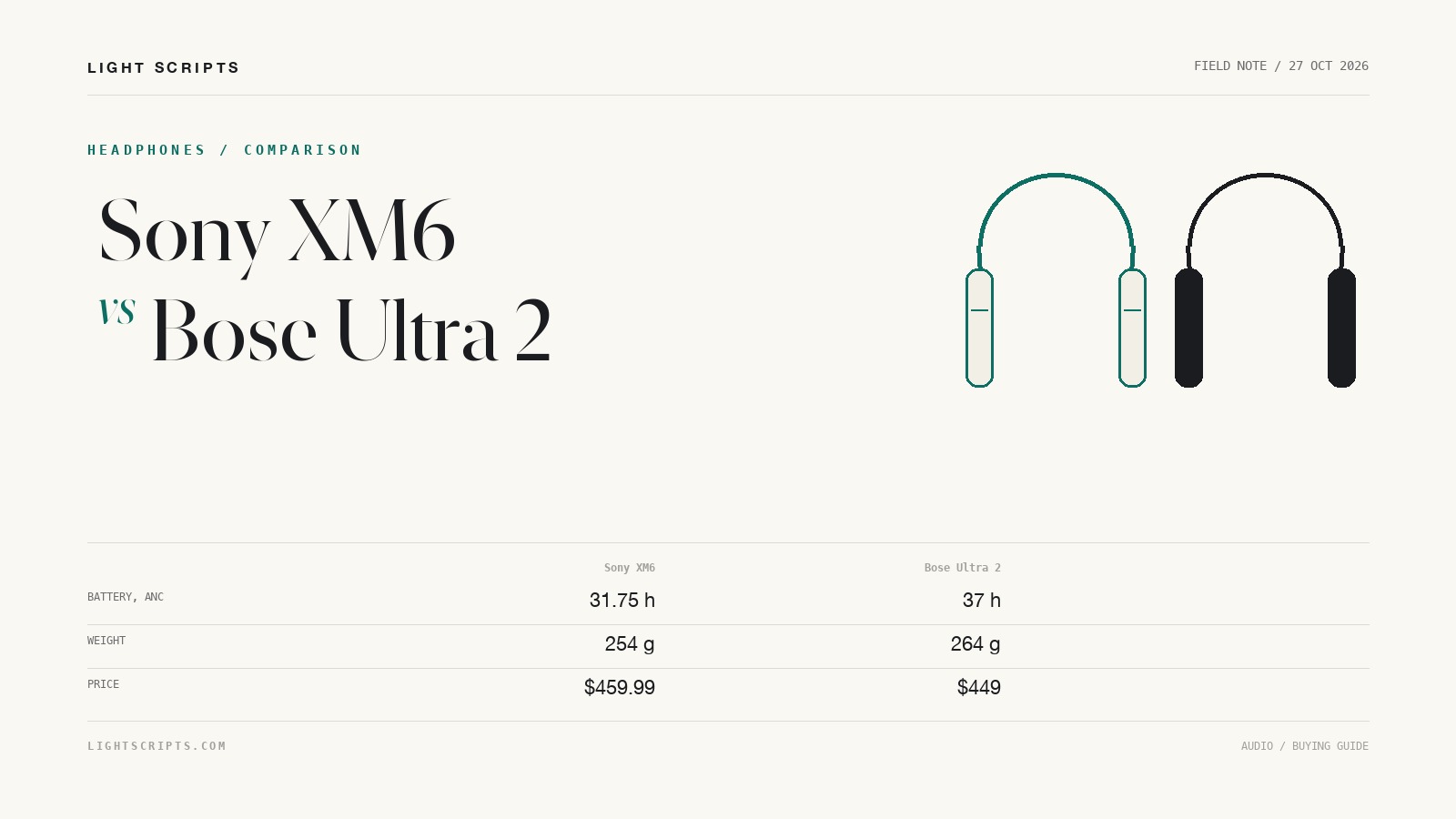
- The Bose lasted 37 hours in RTINGS' battery test against 31.75 hours for the Sony, both with noise cancelling on.
- Sony lists 254 g (8.96 oz), Bose 0.583 lb, about 264 g. Headband shape matters more than those ten grams.
- Sony supports LDAC and LC3 alongside AAC and SBC. Bose supports AAC, SBC, and aptX Adaptive, and adds USB-C audio the Sony lacks.
- As of 27 October 2026, U.S. pricing is $459.99 for the Sony and $449.00 for the Bose.
Sony WH-1000XM6 vs Bose QuietComfort Ultra 2: the numbers
Isolation figures are band averages from RTINGS' published curve. Battery figures are RTINGS' measured runtime. Everything else is from manufacturer spec sheets.
| Measurement | Sony WH-1000XM6 | Bose QC Ultra (2nd Gen) |
|---|---|---|
| U.S. list price | $459.99 | $449.00 |
| Weight | 8.96 oz (254 g) | 0.583 lb (about 264 g) |
| Advertised battery, ANC on | 30 h | 30 h |
| RTINGS measured battery, ANC on | 31.75 h | 37 h |
| Charge time | 3.5 h | 3 h |
| Isolation, 50 to 300 Hz | 27 dB | 19 dB |
| Isolation, 500 to 4000 Hz | 32 dB | 29 dB |
| Isolation, 2 to 8 kHz | 35 dB | 35 dB |
| Bass vs RTINGS target | 5 dB boost | 3 dB boost |
| Treble vs RTINGS target | 1 dB below | 4 dB below |
| Bluetooth version | 5.3 | 5.4 |
What the isolation curves show
RTINGS calls the Sony's isolation "fantastic" and the Bose's "superb", but the curves separate them by frequency.
Below 300 Hz the Sony is clearly ahead: 27 dB of attenuation across the band, hitting about 33 dB around 200 to 250 Hz. The Bose averages 19 dB there and sits near 23 dB at 200 Hz. That range covers jet engines at cruise, ventilation, and truck idle. A 7 to 8 dB gap is the difference between rumble you notice and rumble you forget.
Above 2 kHz the two are tied at about 35 dB, with the Bose fractionally ahead in the top octaves. RTINGS notes the Bose 2nd Gen blocks more treble noise than the first generation it replaces.
The middle is where curve shape beats band average. Sony holds 31 dB near 1 kHz. Bose dips to about 22 dB near 1 kHz, then climbs back above 30 dB by 2 kHz, and that dip sits where vowel sounds and nearby conversation live.
Flying and open-office work are different questions. If you fly, 50 to 300 Hz is most of what reaches you, and the Sony's advantage there is repeatable. RTINGS describes the Sony handling "the rumble of airplane turbines" and the Bose handling "traffic and din" well, and the curves support both. In an office the noise is HVAC rumble plus mid-range speech, and a dip that sits near 1 kHz is more audible in a talkative room than a 3 dB band average suggests. Neither removes speech entirely, since it shares the band with your audio. Seal does most of that work. RTINGS warns Sony performance "may vary depending on the headphones' fit," and both makers run a calibration step that can only optimize what the seal allows.
Weight, clamp, and earcup depth
Sony's spec page lists 8.96 oz, or 254 g. Bose lists 0.583 lb for the headphone and 1.061 lb for the full system with the case. The Bose is about 264 g, so the gap is 10 g, roughly two AA batteries. You will not feel that. RTINGS describes the Sony's flatter headband cross-section as spreading weight across the top of the head and reducing fatigue, but also notes the earcups are shallow enough that ears can touch the drivers through the mesh. The Bose gets a thicker headband pad and angled enclosures, and RTINGS rates it extremely comfortable with light clamp.
Earcup depth is the one spec neither company publishes, and it decides whether either survives an eight-hour day. Buy somewhere with a return window.
Battery: the claim and the measurement
The advertised numbers are identical at 30 hours with ANC on. The measured numbers are not. RTINGS recorded 31.75 hours from the Sony, just over its claim, and 37 hours from the Bose against the same 30-hour claim. That puts the Bose 5.25 hours ahead in the same test, one extra workday before either needs a cable.
Charging favors Bose slightly: 3 hours to full against Sony's 3.5. Sony also lists 24 hours of continuous communication time with ANC on, the figure that matters if these are call tools. Bose publishes no separate talk-time number. Neither includes a power adapter.
Codecs, multipoint, and the phone in your pocket
Sony supports SBC, AAC, LDAC, and LC3, with LDAC published at 990 kbps and 96 kHz sampling at its highest setting. Bose supports SBC, AAC, and the aptX Adaptive suite. On an iPhone both fall back to AAC. On Android without Snapdragon Sound, aptX Adaptive may drop to low-latency mode, so LDAC is the more useful option where supported.
Multipoint works on both. Sony lists multipoint and RTINGS confirms multi-device pairing plus Google Fast Pair and Windows Swift Pair. Bose pairs with two devices.
One gap matters at a desk. Bose accepts USB-C audio at 16-bit, 44.1 or 48 kHz, so it works as a wired USB headset. Sony has no USB-C audio at all. For one cable to a laptop carrying audio and microphone, only the Bose works.
Features that decide the purchase
| Feature | Sony WH-1000XM6 | Bose QC Ultra (2nd Gen) |
|---|---|---|
| Codecs | SBC, AAC, LDAC, LC3 | SBC, AAC, aptX Adaptive |
| Multipoint | Yes | Yes, two devices |
| USB-C audio | No | Yes, 16-bit, up to 48 kHz |
| App EQ | 10-band graphic plus presets | 3-band graphic plus presets |
| Spatial audio | 360 Reality Audio, head tracking | Immersive Audio plus Cinema Mode |
| Spatial audio battery cost | Not published | 23 h with Immersive Audio on |
| Works passively when off | Yes, analog cable | No, mic disabled in wired mode |
| Case | Hard case, magnetic clasp | Semi-hard zip case |
| Published talk time | 24 h with ANC on | Not published |
The EQ difference is the quiet one. Sony's app gives a 10-band graphic EQ, presets, and a questionnaire-driven "Find My EQ" tool. Bose gives a 3-band EQ inside its Modes system. Ten bands notch a specific resonance; three do not.
The passive-listening difference is the practical one. Sony runs from the analog cable with the headphones off, though RTINGS notes this "drastically alters their frequency response." Bose disables the microphone in wired mode and cannot run passively once the battery dies, though it plays while charging.
Using either one for calls at a desk
Neither replaces a headset, and the gap shows up in the microphone tests.
RTINGS rates the Sony's recording quality as good, with boosted bass making voices "intelligible and full-bodied," and its noise handling as great. Against subway noise the system leaked almost no background noise, though intelligibility suffered. Sony also allows a button binding for microphone mute, rare on a consumer headphone and useful on calls.
RTINGS rates the Bose's recording quality as decent with a "fairly flat" vocal-range response, so deep and high voices arrive closer to true. Its noise handling is satisfactory: background noise is lowered and your voice prioritized, but not rejected, and RTINGS notes dropouts from a passing train. Bose counters with an adjustable side tone labeled Self Voice, so you hear yourself while wearing ANC.
Sony has one codec trick the Bose lacks. It supports LC3 over Bluetooth LE with the TMAP profile, and RTINGS published the same call over HFP and over LC3. That only helps if your phone supports LC3, which many recent Android phones do and iPhones do not.
For four hours of calls a day, a boom or desk microphone still beats an array in an earcup at any codec. That trade-off is covered in our look at headsets versus a desk microphone, and the weight and battery math for eight-hour wear is in our wired versus wireless headset breakdown. Our guide to what actually matters in noise cancelling headphones explains which cancellation figures matter for your room.
What spatial audio costs in battery
Bose publishes the cost: 30 hours in Quiet or Aware mode, 23 hours with Immersive Audio on. That is a 7-hour, roughly 23 percent cut, and the figure to plan around if you leave it on.
Sony does not publish an equivalent. Its spec sheet lists 30 hours with ANC on and 40 with ANC off, with no separate number for 360 Reality Audio or head tracking. RTINGS measured 31.75 hours with ANC on and points to microphone use, codecs, and volume as the variables that move it.
The rule is the same on both: turn spatial audio off for travel days, on for movies, and do not expect the headline figure to hold with every processing feature enabled.
Frequently asked questions
Which has better noise cancellation, the Sony WH-1000XM6 or the Bose QuietComfort Ultra 2?
On RTINGS' curve the Sony attenuates more from 50 to 4000 Hz, widest below 300 Hz at about 7 to 8 dB. Above 2 kHz they are within a decibel.
Is the Sony WH-1000XM6 heavier than the Bose QuietComfort Ultra 2?
No. Sony lists 254 g and Bose 0.583 lb, about 264 g, so the Sony is lighter by roughly 10 g. Fit and earcup depth affect comfort more.
How many hours does the Bose QuietComfort Ultra 2 last with spatial audio on?
Bose publishes 23 hours with Immersive Audio enabled, down from 30 in Quiet or Aware mode. Sony publishes no equivalent figure for the WH-1000XM6.
Can I use either headphone for video calls on a laptop?
Both work over Bluetooth. The Bose also accepts USB-C audio at 16-bit, 44.1 or 48 kHz. Neither has a boom microphone.
Do both support multipoint pairing?
Yes. Sony lists multipoint and RTINGS confirms multi-device pairing. Bose pairs with two devices at once.